Understanding Your Camera

I have a “Canon – EOS Rebel SL3 DSLR 4K Video Camera with EF-S 18-55mm IS STM Lens” camera.

“A lightest and smallest — EOS DSLR camera”

In this post let me demystify my camera full model description. While describing it, I will try to highlight alternatives and/or related information for each aspect in the camera name.
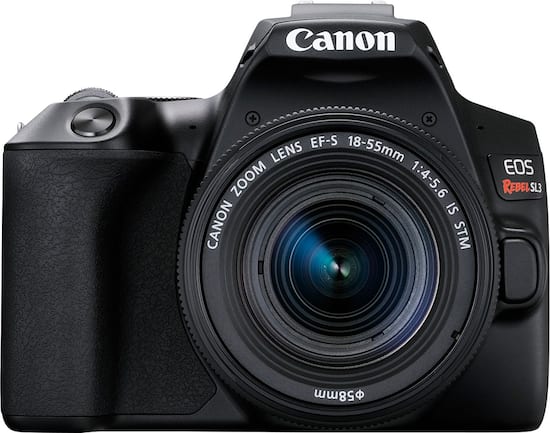
Front Zoom. Canon - EOS Rebel SL3 DSLR 4K Video Camera with EF-S 18-55mm IS STM Lens.

My Camera Description Related or Alternatives Information
Canon
  1. It is a brand.
  2. How to Choose a brand?
    1. Look for wide range of lens the brand provides
    2. Consider Field of View (FOV) – detailed in below 2 points
    3. Full Frame Sensor Camera Body – what you view from this camera body is same as what you see
    4. Crop Factor Sensor Camera Body – size of the sensor is smaller – Field of View is smaller OR image gets magnified by crop factor. Camera
    5. Lenses meant for “Full Frame Camera Body” can be used in “Crop Factor Sensor Body” camera but the other way is not possible
  3. Motion (Live Events, Sports, Wild Life) and Landscape based photographers do not like Crop Factor Camera Body because when they shoot a scene or subject with a Crop Factor (say 1.6 crop-factor value) then the scene gets cropped (i.e. magnified) by crop-factor value. In case of Full Frame Sensor Camera Body cameras they see the scene as it is
  4. Above factors does not mean Crop Factor Sensor Camera Body is bad, advantages of Crop Factor cameras are they can mount any lenses even made for Full Frame cameras and they are cheaper.
  5. DSLR vs Mirrorless Camera is another factor to decide a camera
  6. In Mirrorless, there is sensor directly without mirror
  7. In DSLR we have Optical View Finder, what you see is what you are getting in the frame (that means subject to mirror and to sensor and then Optical View Finder) 
  8. In Mirrorless camera, we will have Electrical View Finder, these are lighter
  9. DSLR’s are generally bulky because of lot of mechanical and electronic components; have lot of buttons
  10. In Case of DSLR it does not have so many electronics compared to Mirrorless

Sony, Nikon, GoPro

Canon has 1.6 Crop factor

Sensors use “photo site” as unit of measure – those are elements used for capturing the “light”

In Crop Factor sensor, no of photo-sites  or photons are less

In Full Frame sensor, no of photo-sites or photons are much larger area the amount of gray area (i.e. noise) comes down, this means more light in the film.

Depth of Field of Full Frame is much better to a Crop Factor sensor

Full Frame sensor camera is much expensive than Crop Factor sensor

EOS
  1. This is specific to Canon brand
  2. Means “Electro-Optical System”
  3. SLR (single lens reflex) camera

Electro-optical, or EO, systems are systems that utilize a combination of electronics and optics to generate, detect and/or measure radiation in the optical spectrum.

This portion of the electromagnetic spectrum, with wavelengths from approximately 0.01 to 1000 micro-meters, includes:
– infrared radiation
– visible light and
– ultra-violet radiation

 
REBEL SL3
  1. Means Canon entry level SLR
  2. It is a Series name to Canon camera 

It is also know as

  • EOS Kiss X10 (in Japan)
  • EOS 200D Mark II (in Australia)
DSLR
  1. Digital Single-Lens Reflex camera
  2. Allows interchangeable lenses on the same camera body


4K Video
  1. 4K means how many vertical lines are there in resolution of an image
  2. Also known as Ultra HD
  3. In simple terms it is a video resolution, or is the size of your picture
  4. When it comes to displays and screens, resolution is the number of pixels the image shows
  5. It translates into the level of detail the picture has
  6. Ultra HD or 4K gives you 3840 by 2160 pixels resolution
  7. That means you can put 4 HD images into one 4K image
  8. 4K has twice the resolution of a standard HDTV, which is 1920 by 1080 pixels
  1. 4K is not only about higher pixels, it also defines the compression, bit rate, and color depth of the film material.
  2. Higher Image Quality – The 4K matrix creates a three-dimensional image that can be well viewed from all angles
  3. You don’t need 3D glasses to view a high-quality three-dimensional picture
  4. More Editing Options
  5. More Attractive Presentation on a Bigger Screen – 
  6. A high number of pixels provides high definition
  7. Ultra HD transmits more colors and more details in the lightest and darkest tones

EF 

(lens that comes with Camera body)

  1. EF stands for “Electro-Focus”
  2. Automatic focusing on EF lenses is handled by a dedicated electric motor built into the lens
  3. All communication between camera and lens takes place through electrical contacts; there are no mechanical levers or plungers
 

EF-S

(lens that comes with Camera body)

  1. Canon EF-S lens mount is a derivative of the EF lens mount created for a subset of Canon digital single-lens reflex cameras with APS-C sized image sensors
  2. The “S” in EF-S has variously been described by Canon as coming from either “Small image circle” (the lens projects a smaller image circle than normal EF lenses to match the sensor), or “Short back focus” (the smaller mirror used in APS-C cameras also allows optical elements to protrude further into the camera body, reducing the minimum distance between the sensor and the back element of the lens).
  3. Combination of a smaller sensor and shorter back focal length distance enhances the possibilities for wide angle and very wide angle lenses.
  4. Lenses designed for the EF-S mount can be made smaller, lighter (containing less glass), faster (larger aperture) and less expensive
  5.